


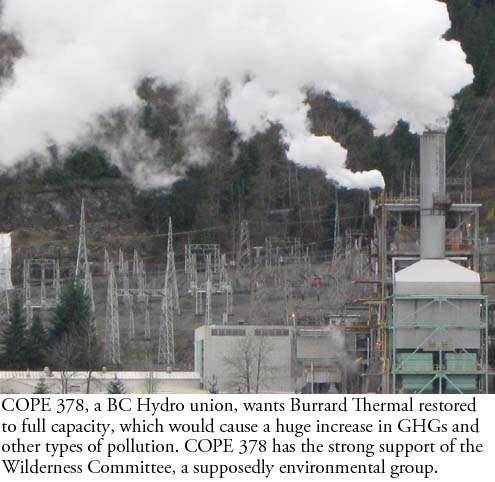
Located on the north shore of Burrard Inlet in Port Moody, Burrard Thermal is a 1960s-era plant that uses natural gas-fired steam to turn turbines and generate electricity. When running at full capacity it was one of Metro Vancouver’s largest sources of CO2 and produced seven per cent of B.C.’s total greenhouse gases, along with other types of deadly air pollution.
 For several years BC Hydro had been cutting back on the aging plant’s output, and therefore its GHG and particulate emissions. But in 2007, the Crown corporation suddenly increased the plant’s output to over 18 times the level of 2006.
Port Moody city council and COPE 378, a union representing some BC Hydro staff, actually want Burrard Thermal restored to full capacity.
COPE 378 has the strong support of the Wilderness Committee, a group that claims to oppose clean electricity on environmental grounds.
Yet Burrard Thermal is the same kind of gas-fired, GHG-emitting plant that was proposed for Sumas 2 and eventually defeated by a broad coalition of Fraser Valley opponents.
Similar proposals for Vancouver Island also met widespread opposition.
Even at its historically low 2006 output, Burrard Thermal was Metro Vancouver’s fourth-largest source of GHGs. In 2007 its GHG output soared dramatically. Restoring it to full capacity would be an environmental obscenity.
Nor does dirty power come cheap. Some $200 million in upgrades has done little to reduce the plant's GHG emissions. As long ago as 2001 the cost of re-powering Burrard Thermal was estimated at $1 billion. Furthermore its power depends on increasingly scarce and expensive natural gas.
Instead of increasing Burrard Thermal’s output, BC Hydro should shut it down. Regardless of what COPE 378 says, Burrard Thermal is a serious source of pollution and should have no place in B.C.’s energy future, except possibly as an emergency backup.