


The finacial risk is too high:
BC Hydro can’t for a number of reasons.
Most importantly, the financial risk is way too high for a publicly owned utility. Energy proposals face a very high rate of attrition. Out of about 480 run-of-river proposals since 1990, only about three dozen have been built. In some cases millions of dollars were spent before a proposal folded. A publicly owned utility can’t risk that kind of money — because it’s our money.
The fin
Independents’ costs are lower. If you compare the projected cost of the Site C dam proposal ($6.6 billion and rising) with the cost of independent projects and adjust for the amount of electricity to be generated, you’ll see that the independents are significantly cheaper.
The $6.6 billion of our tax money that would go to Site C could build 18 and a half 300-bed hospitals. We have to ask whether this is the best use of our money when independent green energy producers can make the investment for us and assume the risk.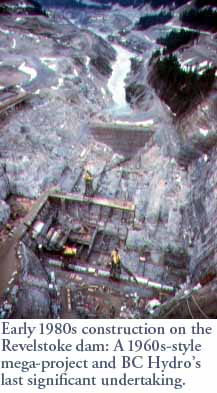
The fin
Green energy projects call for a wide range of expertise that’s foreign to BC Hydro. BC Hydro lacks expertise in anything but building and maintaining 1960s-style mega-projects. The Crown corporation hasn’t built any significant infrastructure since the Revelstoke dam in 1983.
The Site C dam proposal, for example, would flood a 5,100-hectare eco-system.
In 2006 the provincial utility dramatically increased its output from the Burrard Thermal plant, a gas-fired source of GHGs that pre-dates the environmental movement.
In the mid-1990s BC Hydro began a long struggle against local opposition to build a series of similar plants on Vancouver Island. As recently as 2005 the Crown corporation nearly succeeded in Nanaimo with its Duke Point scheme, which was finally scrapped after $120 million in expenses.
That one plant alone would have caused a 25-per-cent increase in the GHGs B.C. produces through electrical generation. That’s equivalent to an extra 145,500 cars on the road.
In addition, BC Hydro lacks the flexibility to juggle several relatively small projects at the same time. Each of these projects requires a lengthy process of feasibility studies, environmental reviews and consultations with First Nations and local communities.
While other provinces and countries have been producing clean, renewable electricity, BC Hydro has stuck to what it knows — outmoded, overpriced, environmentally costly energy projects.